
How Do You Inspect a Safety Harness Before Use?
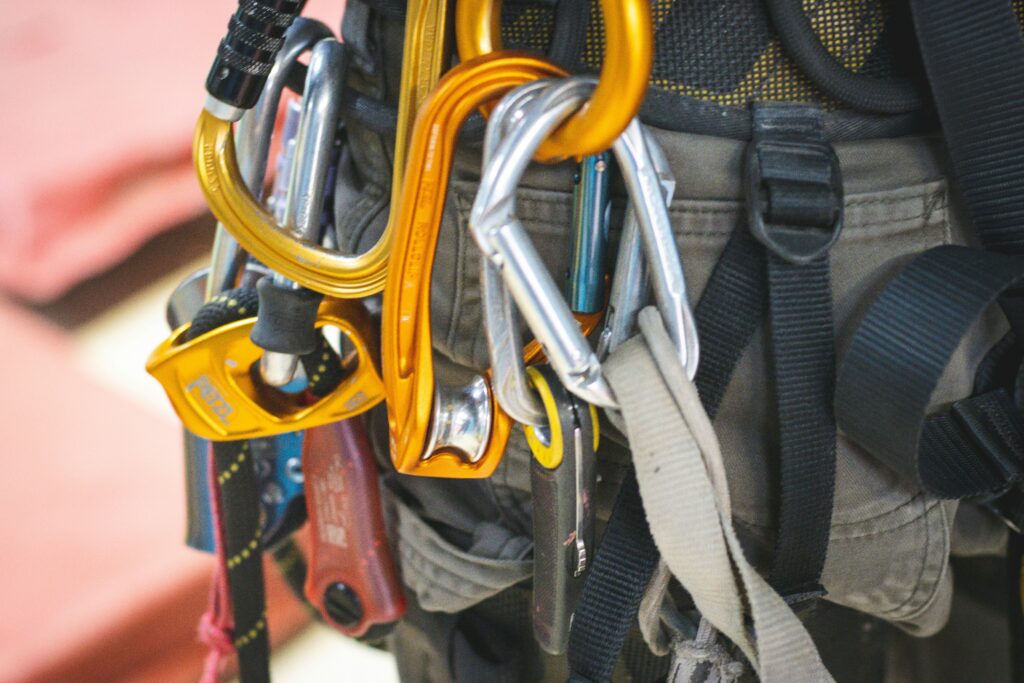 Inspect a safety harness before use by following the same route every time: confirm the harness identity and history, examine every section of webbing, check the stitching, inspect D-rings and other hardware, test buckles and adjusters, and make sure the parts that are supposed to move or lock operate correctly. Look for wear, cuts, tears, abrasion, stretching, deterioration, corrosion, deformation, burns, chemical damage, alterations, or anything else that could affect the harness. If a component is defective, remove the equipment from service rather than guessing that it is still safe.
That last step matters. A pre-use inspection is not a ceremonial glance before climbing. Under OSHA’s construction standard, personal fall arrest systems must be inspected before each use for wear, damage, and other deterioration, and defective components must be removed from service. In general industry, personal fall protection systems must be inspected before initial use during each workshift for mildew, wear, damage, and other deterioration. The exact inspection details for a particular harness also come from its manufacturer and the employer’s fall-protection program.
What Does OSHA Require for Harness Inspections?
OSHA uses slightly different wording for construction and general industry, so it is useful to know which standard applies to the work rather than reducing the rule to “inspect it once a day.” For construction, 29 CFR 1926.502(d)(21) requires inspection of personal fall arrest systems prior to each use. OSHA has also clarified that an annual inspection does not replace that pre-use requirement.
For general industry, 29 CFR 1910.140(c)(18) requires inspection before initial use during each workshift. Defective components must be removed from service. These are minimum regulatory requirements; the manufacturer’s instructions or an employer program may call for additional checks or documentation.
| Work setting | OSHA inspection timing | Core requirement |
| Construction | Prior to each use | Check for wear, damage and other deterioration; remove defective components from service. |
| General industry | Before initial use during each workshift | Check for mildew, wear, damage and other deterioration; remove defective components from service. |
| After impact loading | Separate evaluation applies | Remove the affected system/components from service immediately and follow the applicable inspection and return-to-service requirements. |
Use the Same Harness Inspection Path Every Time
A repeatable sequence makes it less likely that a small but important area will be skipped. One practical route is: label and history → webbing → stitching → hardware → buckles and adjusters → function → final disposition. The component list varies by harness model, so the manufacturer’s instructions remain the product-specific authority.
1. Start With the Harness Label, History and Overall Condition
Before concentrating on individual straps, identify the harness and look at it as a whole. Check the manufacturer’s label and any identification or inspection information required by the employer or manufacturer. An unreadable or missing label should not be casually ignored; whether it requires removal from service depends on the applicable product instructions and employer procedure.
Also consider what is known about the harness. Has it been involved in a fall? Was it exposed to welding, chemicals, excessive heat, sharp edges, or another event that could have damaged it? Has it been stored where moisture, dirt, or contamination could affect the material? A clean-looking harness can still have a history that requires closer evaluation.
2. Inspect Every Section of Webbing
Work methodically along every strap rather than looking only at the chest and shoulder areas that are easiest to see. Inspect both sides where practical. OSHA’s non-mandatory guidance identifies significant concerns such as cuts, tears, abrasions, mold, undue stretching, alterations, deterioration, and contact with fire, acids, or other corrosives.
Use both sight and touch when the manufacturer’s inspection method supports it. Bending or flexing webbing can make some cuts, broken fibers, hard spots, glazing, or other changes easier to notice. Pay special attention near buckles, D-rings, stitched connections, and areas that routinely rub against clothing, tools, structures, or equipment.
Cuts, tears, fraying and abrasion
A small amount of surface fuzz is not the same thing as a deep cut across load-bearing fibers, but a generic article cannot establish every manufacturer’s rejection threshold. Look for broken fibers, tears, edge damage, unusual thinning, excessive abrasion, holes, or other changes from the webbing’s normal condition. If the condition is questionable, stop and follow the employer and manufacturer process instead of deciding by appearance that it “should hold.”
Burns, chemicals, mildew and deterioration
Heat and chemical exposure can change webbing in ways that are not always obvious. Watch for burns, melting or glazing, hard or brittle areas, unusual discoloration, swelling, stiffness, mildew, or contamination. Do not assume that color alone proves UV or chemical damage; the exposure history and manufacturer criteria matter. Paint, heavy dirt, or coatings can also hide defects that need to be seen.
3. Check the Stitching and Load-Bearing Connections
Stitching is part of the load path. Inspect sewn areas for cut, pulled, loose, missing, or broken threads and for webbing damage around the stitch pattern. Look for evidence that a seam has opened, shifted, been altered, or been repaired outside the manufacturer’s authorized process.
Do not re-stitch a harness in the field or treat a home repair as equivalent to the original construction. If a load-bearing stitched connection is damaged or questionable, remove the harness from service and use the employer/manufacturer procedure for evaluation or replacement.
4. Inspect D-Rings and Other Hardware
Check D-rings and other metal hardware for cracks, distortion, corrosion, sharp edges, excessive wear, burns, or other damage. Hardware should not be bent back into shape as a field repair. A deformed D-ring is not merely cosmetic; it is a reason to stop using the harness until the equipment is handled under the appropriate procedure.
If the harness has integral connectors or other hardware, inspect those components according to the manufacturer’s instructions as well. OSHA guidance identifies distorted hooks, faulty hook springs, loose or damaged mountings, and non-functioning parts as conditions that require attention.
5. Check Buckles, Adjusters, Grommets and Strap Keepers
Buckles and adjusters should be examined for deformation, cracks, corrosion, sharp edges, excessive wear, and proper engagement. On harnesses with tongue buckles and grommets, inspect the holes and surrounding material for tearing, stretching, or other damage. Strap keepers should be present and usable where the harness design requires them.
The goal is not simply to prove that a buckle closes. Look at the webbing where it passes through the hardware and make sure the adjustment mechanism has not damaged, cut, or excessively worn the strap.
6. Make Sure Moving Parts Function Correctly
Operate the buckles, adjusters, gates, or other moving components that the manufacturer directs the user to check. Parts should move and lock as designed. Dirt, corrosion, deformation, or damage that prevents normal operation is not something to work around.
Avoid adding lubricants, cleaners, paint, tape, or other substances unless the manufacturer specifically permits them. A well-intended maintenance shortcut can damage material, conceal a defect, or interfere with a component’s function.
7. Make a Final PASS or REMOVE-FROM-SERVICE Decision
The inspection ends with a decision, not with a checklist mark. If the harness is defective, remove it from service. If a condition is uncertain, do not improvise a repair or make up an acceptable-damage threshold. Tag or segregate questionable equipment according to the employer’s procedure and obtain the evaluation required by the applicable standard and manufacturer instructions.
| Harness area | What to examine | Examples of concerns | If defective or questionable |
| Label / history | Identification, instructions, known exposure or fall event | Missing/illegible information where required; unknown impact history | Stop and follow employer/manufacturer procedure. |
| Webbing | Both sides of straps and high-wear areas | Cuts, tears, abrasion, broken fibers, burns, stretching, deterioration, contamination | Remove from service if defective; do not field-repair. |
| Stitching | Load-bearing sewn connections | Cut, pulled, broken or missing threads; opened seam | Remove from service; do not re-stitch. |
| D-rings / hardware | Shape, surfaces, mountings, corrosion | Cracks, deformation, sharp edges, corrosion, loose mounting | Remove from service; do not bend back into shape. |
| Buckles / adjusters | Engagement, movement, wear at webbing | Bent parts, poor engagement, excessive wear, damaged grommets | Stop use and follow product/employer procedure. |
| Moving parts | Normal operation and locking | Sticking, non-functioning or damaged parts | Remove from service if defective. |
What Harness Damage Means It Should Be Removed From Service?
OSHA’s construction guidance is intentionally conservative: a component with a significant defect—such as cuts, tears, abrasions, mold, undue stretching, alterations, deterioration, fire or corrosive damage, distorted hooks, buckle problems, damaged mountings, or non-functioning parts—should be withdrawn from service. General-industry guidance follows the same basic principle.
What OSHA does not provide is a universal visual chart that makes every harness brand acceptable up to the same amount of wear. Product construction differs. If the manufacturer sets a stricter rejection criterion, that instruction matters. The safe decision is not to “average” several checklists found online.
What If the Harness Has Been Involved in a Fall?
Impact loading is different from ordinary pre-use inspection. In construction, OSHA requires personal fall arrest systems and components subjected to impact loading to be immediately removed from service. They cannot be used again for employee protection until a competent person has inspected them and determined they are undamaged and suitable for reuse. General industry likewise requires impact-loaded systems or components to be removed immediately and not used again until a competent person determines they are not damaged and are safe for use.
Do not assume a harness is reusable because there is no obvious tear. Follow the applicable OSHA requirement, employer procedure, and manufacturer instructions after any fall-arrest event.
Pre-Use Inspection Is Not the Same as a Fit Check
Condition and fit answer different questions. Inspection asks whether the harness and its components show damage or deterioration. A fit check asks whether the correct harness is donned and adjusted properly for the worker and intended use. A harness can pass a condition inspection and still be worn incorrectly.
That distinction is useful during training because it prevents “I looked at it” from becoming a substitute for correct donning, adjustment, connection, and use.
A Harness Inspection Is Not a Complete Fall-Protection-System Inspection
The harness is only one part of a personal fall-protection system. Lanyards, self-retracting devices, connectors, lifelines, anchorages, and other components have their own inspection and compatibility requirements. A harness in excellent condition does not make a damaged connector or unsuitable anchorage acceptable.
OSHA’s construction guidance also cautions that fall-arrest components are not automatically interchangeable. Any substitution or change needs to be evaluated so the complete system continues to meet the applicable requirements. This is another reason a harness checklist should not be treated as a complete fall-protection inspection.
Common Safety Harness Inspection Mistakes
Several shortcuts reduce the value of a pre-use inspection. One is checking only the front of the harness. Another is looking at webbing but skipping stitching and hardware. Workers may also confuse an inspection with a fit check, assume a scheduled formal inspection eliminates the pre-use check, or keep questionable equipment in circulation because the defect looks minor.
A more reliable habit is simple: follow one route, inspect the whole harness, know the manufacturer’s criteria, and make a clear disposition decision before the equipment is used.
How New Mexico Work Conditions Can Affect Harness Condition
The basic inspection requirements do not change just because work is in Albuquerque or elsewhere in New Mexico. The work environment can, however, change what deserves attention. Outdoor construction may expose equipment to intense sun, heat, wind and dust. Welding or hot work can expose fall-protection components to heat and sparks. Industrial work may involve oils, chemicals, abrasive surfaces, or contaminants.
OSHA’s construction guidance specifically says the work environment—including acids, dirt, moisture, oil, grease, hot or cold conditions, and seasonal weather changes—should be considered when selecting and monitoring personal fall-protection systems. Storage, cleaning, and inspection practices should therefore reflect the actual exposures on the job.
Frequently Asked Questions
Does a safety harness need to be inspected before every use?
For construction personal fall arrest systems, OSHA requires inspection prior to each use. General industry requires inspection before initial use during each workshift. Employer procedures and manufacturer instructions may add requirements.
Can you repair a cut or frayed safety harness?
Do not improvise repairs to load-bearing webbing, stitching, or hardware. Defective components must be removed from service. Any manufacturer-authorized repair or disposition should follow the product instructions and employer procedure.
Does a fall-protection harness expire?
There is no single expiration date that can be applied to every harness from a generic article. Service-life and retirement criteria depend on the manufacturer, product, condition, exposure history, applicable standards, and employer program. Inspect the equipment as required and follow the manufacturer’s current instructions.
What if the harness label is unreadable?
Do not guess. Identification and labeling requirements vary by product and manufacturer. Follow the manufacturer’s instructions and the employer’s equipment-control procedure to determine whether the harness must be removed from service.
Who can perform the pre-use inspection?
For construction, OSHA has clarified that the pre-use inspection required by 1926.502(d)(21) does not itself have to be performed by a competent person; however, employees must be trained in the correct procedures for inspecting the fall-protection systems they use. Impact-loaded equipment is different: the applicable standards require a competent-person inspection before reuse.
Do lanyards and self-retracting lifelines need separate inspections?
Yes. A harness check does not replace inspection of the rest of the system. Inspect lanyards, self-retracting devices, connectors and other components under the applicable OSHA requirements, employer program, and manufacturer instructions.
Fall Protection Training in Albuquerque, New Mexico
Knowing what to look for is easier when workers have handled the equipment and understand how the complete fall-protection system works. Safety Counselling has served New Mexico businesses since 1973 and provides workplace safety training and consulting from its Albuquerque training facility. Its current Fall Protection Training includes fall-protection equipment, fall arrest and fall restraint, and Safety Counselling describes its qualified-person training as combining instructor-led education with hands-on demonstrations that include equipment inspection and harness fitting.
For current fall-protection training options, class dates, or employer training needs, contact Safety Counselling at (505) 881-1112 or visit the Fall Protection Training Albuquerque page. Safety Counselling is located at 2900 Wellesley Dr. NE, Albuquerque, NM 87107.
Authoritative References
- OSHA — 29 CFR 1926.502, Fall Protection Systems Criteria and Practices
- OSHA — Appendix C to 1926 Subpart M, Personal Fall Arrest Systems
- OSHA — 29 CFR 1910.140, Personal Fall Protection Systems
- OSHA — Appendix C to 1910 Subpart I, Personal Fall Protection Systems
- OSHA — Construction Fall Protection Interpretation, Dec. 18, 2003
Educational notice: This article provides general workplace-safety information. It does not replace the applicable OSHA standard, a site-specific hazard assessment, employer procedures, manufacturer instructions, or required training.