
What are the Basics of Fall Protection Safety Protocols on Construction Sites?
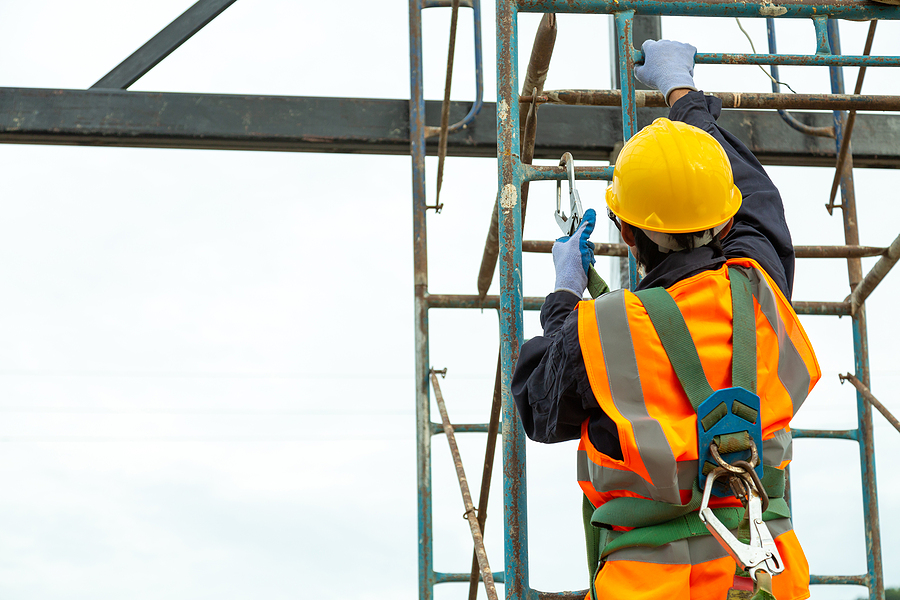
Falls, slips and trips remain among the top causes of fatalities within the construction workforce, comprising nearly 40% of all construction related deaths in 2019 according to BLS statistics.
This is precisely why construction companies must take a proactive approach to prevent workers from falling on the jobsite. This must be accompanied by prevention planning, fall protection training and equipment, and risk management.
All best practices for fall protection should be used on all job sites, but OSHA mandates use of fall protection for the construction industry when working six feet or more in height, and anytime a worker is working over hazardous equipment and machinery regardless of height in all industries.
How to protect construction workers from falls
Preventing falls to construction workers is proactive and must be anticipated and protected against before a worker is exposed to a fall hazard at a job site.
During pre-construction, the design and construction teams collaborate on forecasting potential construction problems of the project.
At this same time also, possible safety risks should be analyzed, lessons learned from experience and best practice within the industry implemented to either eliminate or mitigate possible fall hazards throughout the lifecycle of the project. At this stage recommendations can be researched, analyzed and adopted long before construction actually takes place providing a safer scenario for the construction labor force and the final users.
By anticipating the start of any major work the project will continue to reduce fall hazards on the jobsite as construction progresses. Workplace fall incidents often occur under the following conditions: · Walking/working surfaces that are cluttered, unstable, or slippery · Openings in floor and walls and unprotected edges · Improper use of personal or fall protection that is permanent
Keeping things clean and organized also helps to prevent slips/trips/falls. Danger of dropped objects and wrenched ankles is mitigated with good edge and hole protection.
Proper fall protection training, inspection, and use of guardrails and barriers can eliminate falls on construction sites. Examining and actively managing these types of fall hazards on a regular basis will help produce safe, effective and productive projects.
Hierarchy of controls in construction
Exposure control is the essential way that workers are protected. Historically, this has provided the basis for a hierarchy of controls that has been used to ascertain how we should implement feasible and effective control solutions. An example of this hierarchy is :
The rationale for this hierarchy is that the control methods higher up on the graphic may be more effective and more protective than lower methods. If adhered to, this hierarchy will typically result in the application of inherently safer systems, in which the chances of disease or injury have been significantly lessened. SOURCE: NIOSH
Fall protection training
This type of training must be carried out, and reinforced, with each employee before starting each job. Any construction work requires training which should be given by an instructor with appropriate qualifications or certifications.
This training should not only occur during the initial training process but, but should be an ongoing process throughout the worker’s career in construction to ensure workers are up to date on the most recent best practices and fall protection equipment.
Fall protection equipment
In addition to safety and preventative measures on construction sites, there is also need for proper fall protection to be used and worn which serves to protect both workers and companies. These tools are sometimes components of a larger system known as a fall arrest system, which incorporates several of these tools acting together to prevent a person from falling. Examples of fall protection equipment include the following:
- Buckets: used to directly connect to a lifeline or anchor point, keeping workers out of fall hazard zones
- Lanyards: short lengths of webbing or wire connected to a safety harness D-ring
- Lifelines: a rope or wire connected between a safety belt/harness to the anchor point
- Full body harnesses: disperse the tension of a fall protection system among the thighs, pelvis, waist, chest, and shoulders of the wearer and are also helpful in keeping the body upright to absorb the fall in the best way possible
How does Safety Counselling keep workers safe from falls?
Safety Counselling is constantly committed to keeping all workers safe on the jobsite. Among the hierarchy of controls, the most effective option is always to eliminate the hazard, followed by substitution or engineering the hazard out.
We too often in the trades grab for the Personal Fall Arrest System- a lanyard, a body harness etc.- before assessing a situation and trying to find a way to eliminate and/or engineer a hazard out because it takes a little longer or costs a little more.
Generally, the care taken upfront is advantageous to all, it saves time, money and lives in the long run.
One of the most serious threats that exists on our jobsite, falls from heights, are also one of the easier to eliminate.
Learn and observe your own jobsite and apply the strong lifesaving fall prevention measures.